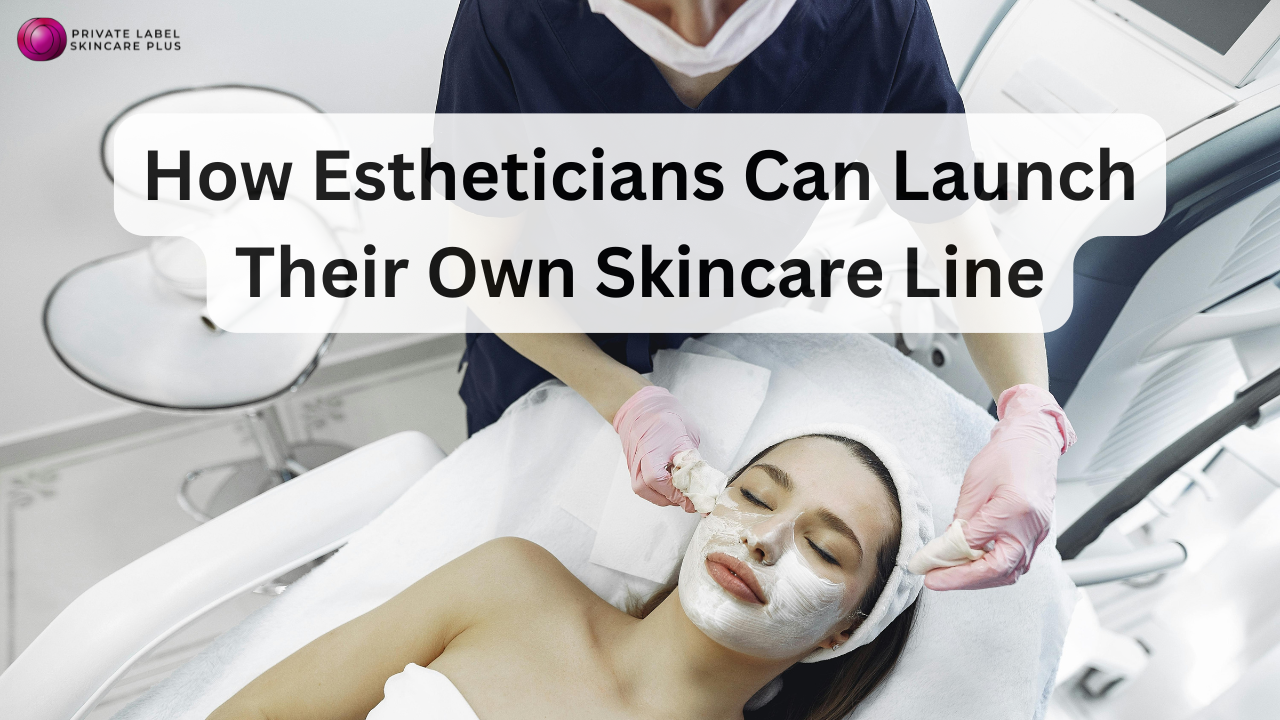
Estheticians can launch their own private label skincare line by partnering with a manufacturer who produces products under their brand name, with low minimum order quantities, professional packaging, and formulas already developed and tested. It requires no chemistry background, no lab, and far less investment than most estheticians expect. The result is a professional product line that builds your brand, deepens client loyalty, and significantly increases your revenue per visit.
If you have been doing facials for years, recommending other brands’ products, and watching your clients buy those same products elsewhere, this article is for you.
Why Estheticians Are Perfectly Positioned for Private Label
Most estheticians spend years building trust with their clients. You understand their skin better than anyone. You know which concerns keep coming back, which ingredients deliver results, and what your clients are willing to invest in their skin.
That expertise is enormously valuable, and right now, most estheticians are giving it away for free every time they recommend someone else’s product.
When a client buys a serum from a brand you recommended, that brand earns the sale, builds the relationship, and keeps the margin. When a client buys a serum with your name on it, you earn the sale, deepen the relationship, and build something that grows beyond the treatment room.
Private label makes the second scenario accessible to independent estheticians and small studio owners, not just large spa chains or well-funded beauty entrepreneurs.
What Private Label Actually Means for an Esthetician
Private label skincare means partnering with a manufacturer who produces ready-formulated, professionally tested products that are packaged and labeled under your brand. You choose the products, approve the formulas, design your label, and sell them as your own.
You do not formulate anything. You do not need a lab, a chemist, or a cosmetic science degree. The manufacturer handles production, stability testing, and compliance. You focus on your brand, your clients, and your business.
At Private Label Skincare Plus, stock formulations, pre-developed, tested, and ready to brand, are available from as little as 100 units. That means you could launch your first product with a modest investment and test it directly with your existing client base before scaling up.
How a Private Label Line Changes Your Revenue Model
Here is where the numbers become compelling. Consider a typical esthetician charging $90 for a facial. The client leaves happy. If they buy a retail product from you — say a moisturizer priced at $45 — you might earn $15 to $20 in margin if it is a third-party brand you have purchased at wholesale.
Now consider the same scenario with your own private label moisturizer. Your cost per unit at 100 units might be $10 to $14, depending on the formula and packaging. You retail it at $45 to $55. Your margin is now $31 to $45 on that single product sale.
Multiply that across a full client week, and then across a product line of three or four SKUs, and a private label range can add thousands of dollars per month to a practice that has not changed a single treatment on its menu.
Beyond the margin, there is the repeat purchase factor. When a client loves a product with your name on it, they come back to you to buy it. They cannot find it on Amazon or in a department store. You become their only source, which means every replenishment purchase brings them back into your orbit, online or in person.
What Products Should an Esthetician Launch First?
The smartest approach is to start with one or two products that complement your most popular treatments and solve your clients’ most common ongoing concerns.
A hydrating or barrier repair moisturizer is the most universally useful starting point. Almost every client needs daily hydration; it suits multiple skin types, and it is easy to recommend as a post-treatment essential regardless of what facial they have had.
A targeted serum, vitamin C for brightening, niacinamide for congestion and redness, or a peptide formula for anti-aging, gives you a higher price point product and a strong retail conversation starter. Serums also have excellent perceived value and are frequently repurchased.
A gentle daily cleanser rounds out a basic starter line and ensures clients are not undoing your treatment work with a harsh supermarket wash at home. A cleanser is low-drama to recommend and creates a daily touchpoint with your brand in their routine.
Three products. One cohesive brand. That is enough to start building meaningful retail revenue and a recognizable identity beyond your treatment room.
Naming and Branding Your Line
Your private label line does not need a separate business name, though many estheticians choose to create one. It can be as simple as “[Your Name] Skincare” or “[Your Studio Name] Essentials.” What matters more than the name is consistency: consistent packaging, consistent tone, and a consistent story about why you created it.
Clients buy from estheticians they trust. Your story, that you created this line specifically for the skin concerns you see every day in your practice, is a more compelling sales narrative than any celebrity-backed brand can offer. Use it.
Keep your packaging clean and professional. Silk screen printing directly onto bottles and jars elevates the look significantly over paper labels and is now accessible even at low order quantities. The first impression of your product on a bathroom shelf matters every single day.
Common Concerns Estheticians Have — Answered
“I don’t have time to manage inventory.” At 100 to 200 units per product, inventory management is minimal. A small shelf or storage cupboard is all you need. You are not running a warehouse.
“What if my clients don’t buy retail?” Some will not — and that is fine. But many clients who never bought retail from you before will buy when it is your product. The personal connection changes the conversation entirely.
“I’m worried about the upfront cost.” Starting at 100 units keeps the initial investment manageable. Many estheticians pre-sell to their existing client list before their first order even arrives — covering the cost before a single product is produced.
“What if I need to change the formula later?” With stock formulations, you are choosing from already-developed, proven formulas. If you later want something exclusive to your brand, custom formulation is available from 500 units, once you have validated demand and built a customer base.
Conclusion
Estheticians already have everything a skincare brand needs: expertise, trust, an existing client base, and a deep understanding of what their customers’ skin actually needs. Private label removes the one barrier that has historically kept that opportunity out of reach — the complexity and cost of product development.
With low MOQs, professional packaging, and the support of an experienced manufacturer, launching your own product line is more accessible than it has ever been. The estheticians building private label brands today are not waiting until they have a bigger studio or a larger following. They are starting with what they have — and growing from there.
Frequently Asked Questions
Do estheticians need a license to sell skincare products? Requirements vary by state and country, but in most regions, estheticians can legally retail skincare products without additional licensing beyond their existing esthetician certification. Always check your local regulations before launching.
How much does it cost to start a private label skincare line? With stock formulations and low MOQs starting at 100 units, initial investment can be very manageable — often a few hundred to low thousands of dollars depending on the product and packaging choices.
Can I sell my private label products online as well as in my studio? Absolutely. Many estheticians run a simple Shopify or Instagram shop alongside their in-person practice, which extends their retail reach well beyond their local client base.
How do I choose which formulas to use? A good private label manufacturer will guide you through this. At Private Label Skincare Plus, we offer free professional consultations to help you match formulas to your treatment specialty and client skin concerns.
What is the difference between private label and white label skincare? White-label products are sold generically to many brands without customization. Private label products are branded specifically for you — your name, your logo, your identity — giving your line a distinct and ownable presence in the market.